

Optimizing IGU Service Life: What Really Determines Long-Term Performance

An article in USGlass Magazine by Helen Sanders
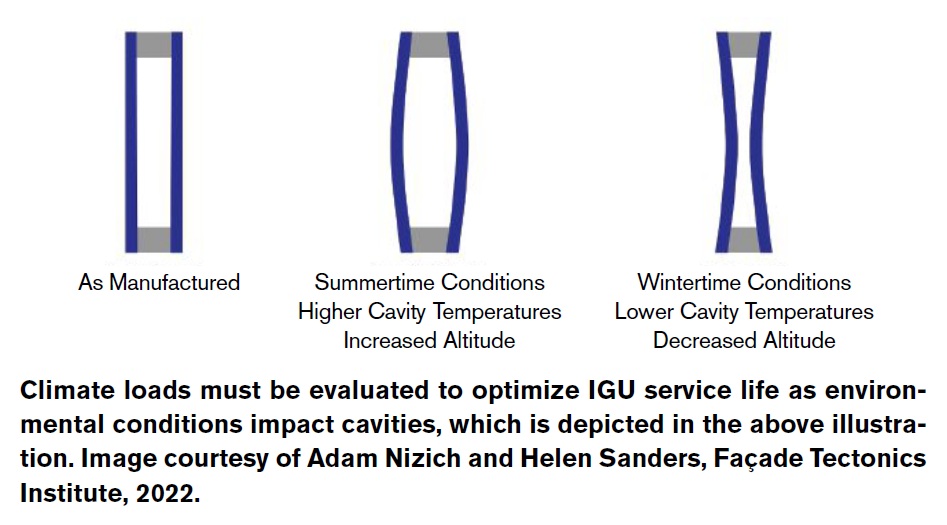
An insulating glass unit’s (IGU) service life is key in determining façade retro-fit schedules and cost of ownership. The shorter the service life, the more frequent costly glass replacement occurs. After a unit fails and before it’s replaced, the IGU’s reduced thermal performance increases the building’s energy consumption, as well as becoming an eyesore. There are several drivers of IGU service life that should be controlled.
IGU Edge Seal Design
The IGU spacer and sealants are critical and must be chosen based on application specifics. Some edge seal systems used in residential-style applications are not suitable for the increased stresses of commercial applications, i.e., higher temperatures, greater mechanical loading, ultraviolet (UV) radiation exposure and more exposure to water in the frame.
Edge seal systems used in residential applications typically meet the requirements of ASTM E2190, like those used in commercial applications. This ASTM standard does not provide application-specific information. Additional considerations are necessary to assess the applicability of edge seals in commercial applications.
Silicone is the secondary sealant typically used in North American commercial applications. This is because of its high resistance to temperature, UV radiation and water and its structural strength. Silicone must be used in structural glazing applications.
Because of silicone’s high permeability to water vapor and argon, it cannot be relied upon as a vapor and gas barrier. The primary sealant and spacer must, therefore, have excellent barrier properties. This is why spacers with a solid metal vapor barrier (aluminum, stainless steel and plastic hybrid stainless steel box spacers) have successful track records in commercial glazing.
Fabrication Quality
Edge seal design should be optimized for manufacturing by error-proofing and building in quality. Considerations include spacer connection points, minimizing penetrations and maximizing desiccant capacity. Robust process control and quality management systems supporting consistent high-quality production are important.
Serviceability Design
The impact of climate loads from high and low temperature extremes, altitude changes and windloads is often not evaluated. These loads can cause excessive extension of the edge seal, increasing the cross-sectional area for vapor and gas transmission and potentially reducing service life.
The force on the edge seal depends on the climate load and the flexibility of the IGU. Narrow units with thick lites are stiff. Under load, the glass cannot deflect to equalize the pressure difference between the cavity and external atmosphere, so the edge seal extends instead. Wide cavities or triple-lite units typically experience higher edge loads.
Installing IGUs to IGMA’s glazing guidelines is also critical for managing service life. Each lite’s edge must be supported with setting blocks of compatible material. Edges must be protected from water accumulation.